
Daviess Projected Versus Actual Release
A projected date is a sentence calculation or planned event. It is not the final proof that a person left custody. For a pretrial detainee at the Daviess/DeKalb Regional Jail, there may be no sentence-based date at all. Bond may allow release when conditions are met, while a judge can change the custody order. Another county, MDOC, federal authority, or ICE may also have a hold. The regional jail’s final movement record establishes what actually happened to the local stay.
Sentenced custody adds date terms that must not be blended. Missouri uses minimum release date for the calculated conditional-release point on an active state sentence. A maximum release date is the maximum or expiration date in the sentence data. A parole date follows a separate Parole Board process. A locally sentenced jail term calls for the judgment, credit for time already served, and the jail’s own computation. None of these records alone promises a community exit on a set day.
Note: A hearing date, court appearance, bond review, or transfer date should never be relabeled as a Daviess County projected release date.
Find a Daviess Projected Release Date
First identify the custody system. The Daviess/DeKalb Regional Jail is an independent regional facility, not a state prison and not a sheriff-run jail. A person who left Pattonsburg for MDOC remains incarcerated after the local movement. The Daviess County release search and records route can establish whether the regional-jail event was a community release or a transfer. Only then does the correct date source become clear.
- Determine whether the person is pretrial, serving a local jail term, or committed to MDOC.
- For pretrial custody, read Case.net for bond and custody orders without treating the next hearing as a release date.
- For a local sentence, request the judgment, jail-credit record, and computation from the regional jail.
- For state custody, search the MDOC Offender Search by DOC number or a sufficiently specific name.
- Use the nightly offender data when the public profile omits a needed minimum or maximum field.
- Ask the institutional parole office about a named person’s release date or home plan.
- Recheck close to the date, then confirm the actual movement with the jail or institution.
Match the person carefully. MDOC’s public search covers active offenders, including prisoners, probationers, and parolees, but excludes discharged offenders from the live locator. An institution assignment means the person has not left state incarceration. A field assignment means the person is outside prison under MDOC supervision. No active profile is inconclusive without the historical file or a records response.
Missouri Minimum Release Date Computation
MDOC’s official data layout labels the active-sentence minimum field as Sentence-I Minimum Release Date. The maximum field is Sentence Maximum Release Date. The MDOC glossary equates minimum release date with conditional release. Most non-life sentences have an incarceration part and a supervised part, but the sentence, offense date, classification, and governing law decide how the parts work. These fields should be read as official calculations, not as a do-it-yourself subtraction from the sentence length.
RSMo § 558.019 creates key minimum prison terms, but it does not require every Missouri prisoner to serve 85 percent. Covered dangerous felonies can carry an 85 percent minimum before parole, conditional release, or another early release, subject to the statute’s terms. Specified non-dangerous felony cases can carry 40, 50, or 80 percent minimums based on prior prison commitments. A minimum term controls eligibility. It does not guarantee release on the first eligible day.
Missouri conditional-release terms also arise under §§ 558.011 and 217.730 and MDOC rules. Jail credit, consecutive or concurrent sentences, program duties, conduct, detainers, later court orders, and a Parole Board decision may alter the visible calculation or actual exit. MDOC specifically warns that a required sex-offender program can affect conditional release when it is not completed.
The statutory minimum-term screenshot below comes from the official Missouri Revisor page.
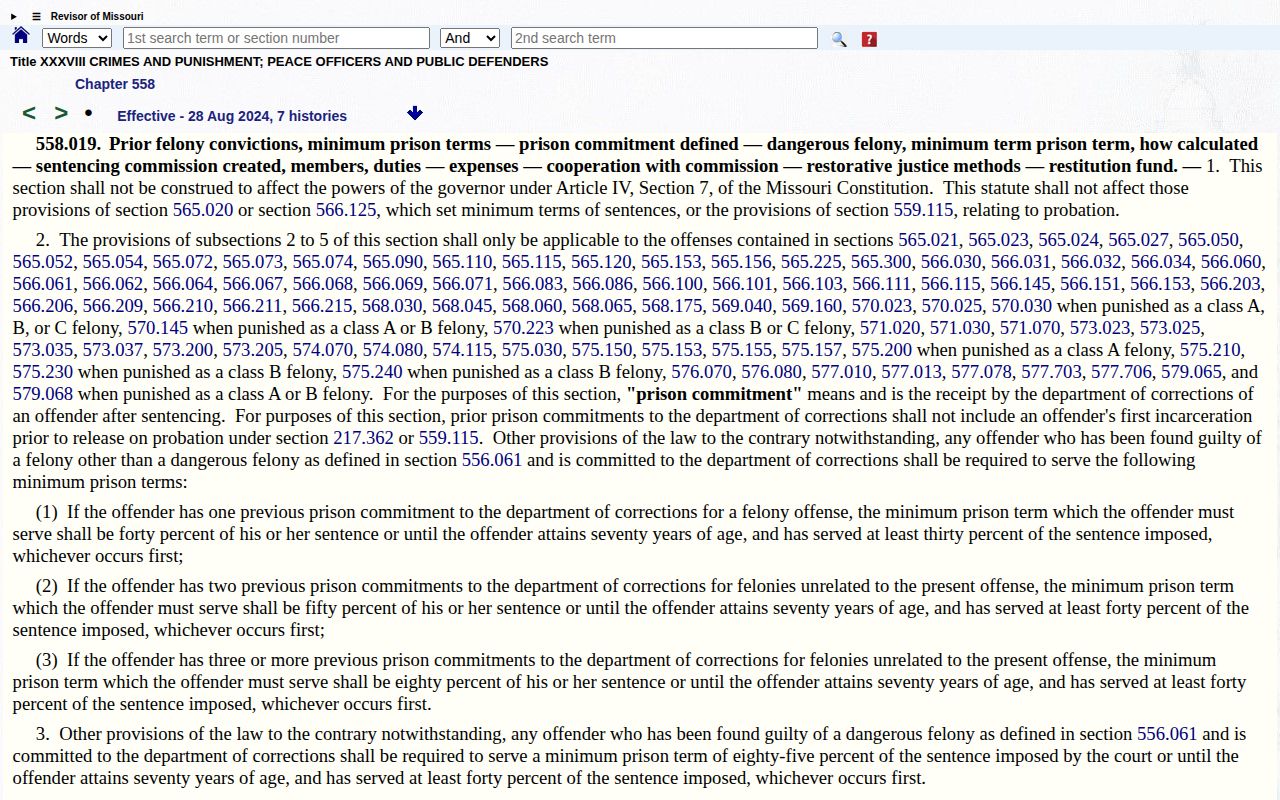
Its text supports a case-specific review of the judgment and statute, not a blanket 85 percent estimate for all Daviess County cases.
Why Daviess Release Dates Change
A date can move because the facts or legal authority changed. Some factors alter the sentence computation. Others leave the date intact but prevent community release. The safest check reads the date, custody status, and receiving authority together. A release from one system can be a transfer into another.
| Factor | Possible effect | Source to check |
|---|---|---|
| Jail credit or sentence correction | Changes the computation base | Judgment, amended order, jail calculation |
| Consecutive or concurrent terms | Changes how multiple sentences combine | Court judgment and MDOC sentence record |
| Program or conduct issue | Can change conditional-release timing | Institution and MDOC record |
| Detainer or other-agency hold | Can cause transfer instead of community release | Final movement and receiving agency |
| Parole Board action | May set a future date or another hearing | Board or institutional parole office |
| Later court order | Can modify custody or sentence | Case.net and Circuit Clerk record |
No official Daviess/DeKalb Regional Jail policy was verified for local “good time,” an automatic Friday release, or a weekend advance. A rule from another county cannot fill that gap. For a local term, ask the regional jail to identify the governing computation and provide the judgment and jail-credit figures it used.
Confirm Daviess County Actual Release
Missouri’s current event-notification service is MOVANS. It replaced local VINELink delivery on May 5, 2026. Search one person in the state portal, match the reporting agency, and subscribe by SMS or email. A MOVANS event can alert a reader to a custody change, but it is not the court order or certified release record. The Daviess County VINELink Inmate Search page explains the current MOVANS workflow and the retired phone and app channels.
For a regional-jail event, call the Daviess/DeKalb Regional Jail and ask for the final movement, release or transfer code, authority, and receiving agency. For MDOC, contact the reporting institution or Constituent Services. MOVANS data can lag, and DPS warns that a local jail may be offline. No result is not proof of release.
Federal and immigration custody require separate systems. A BOP projected date concerns a federal sentence. ICE’s locator concerns current or recent immigration detention. Neither establishes the end of a Daviess County jail episode unless the local movement record shows a matching federal handoff.
Note: Confirm both the end of Daviess County custody and the absence of a transfer before calling the event a community release.
Daviess Release Date Field Meanings
The nightly MDOC file preserves more sentence structure than the live profile may display. It contains the DOC ID, institution-versus-field flag, case number, offense and sentencing counties, completed flag, sentencing date, minimum release date, maximum release date, probation date and type, and supervision terms. A historical record may remain in that file after active supervision ends.
| Field or status | Meaning for release research |
|---|---|
| Minimum release date | Calculated conditional-release point on an active sentence |
| Maximum release date | Maximum or expiration date maintained for the sentence |
| Institution flag | Person remains assigned to state incarceration |
| Field assignment | Person is in the community under MDOC authority |
| Completed flag | Historical data may show an ended sentence or supervision record |
The MDOC Sunshine page says the file is updated nightly and includes current and former supervision data reaching back decades, while warning about conversions and accuracy. For a same-day event, contact the institution. For an older Daviess County record, combine the file with the judgment and any discharge entry.
Daviess Local Sentence Computation
A Daviess County local sentence remains distinct from an MDOC sentence. Request the regional jail’s computation, the judgment, and the credit applied for time already spent in custody. If the person was held for another jurisdiction, identify which judgment controlled each day. The regional jail serves several jurisdictions, so the fact that someone stayed in Pattonsburg does not prove a Daviess County court set the term.
Ask the Circuit Clerk for the judgment, amended sentence, bond or release order, and docket entries by case number when possible. Remote Case.net access does not make every public document downloadable. A courthouse terminal or clerk request may provide a public document that is not linked online, subject to court rules. A missing web document is not proof that no order exists.
Use exact request terms: booked name, booking number, admission dates, final movement, sentence computation, jail credit, releasing authority, and receiving agency. If a code is not plain, ask for the code dictionary. That record-specific route is the only supported local computation section because no verified regional-jail good-time or weekend-release policy was found.
A bond or recognizance release requires a different reading. It ends physical custody while the criminal case continues, subject to the court’s terms. A dismissal or release order can remove the cited case as authority to hold, but another warrant or detainer may remain. Time served means the local custodial term ended, again subject to other holds. Each event can look like “release” at the first jail while leading to a different legal outcome.
Transfers need special care. The regional jail’s dated policy describes outside-agency pickup with positive identification of the receiving officer and related documentation. A request may seek the receiving agency and transfer record while allowing protected personal identifiers to be redacted. That evidence distinguishes departure from Pattonsburg from entry into the community. If the recipient was MDOC, the state minimum and maximum release fields govern the later prison episode.
Close to an expected local date, confirm whether the judgment has changed, whether all jail credit was posted, and whether any new hold exists. Then ask the jail for the actual final movement after it occurs. The projected date answers when release might happen under the present computation. The completed movement answers when and where control actually changed.