
Daviess County Parole Versus Probation
Probation and parole can both involve reporting to the Missouri Department of Corrections Division of Probation and Parole, but they do not start the same way. A Daviess County judge may order probation, often instead of prison or after a short period of confinement. The Missouri Parole Board may release an eligible state prisoner on parole. Conditional release is set by the structure of a Missouri prison sentence and state law. None of these terms describes every person who leaves the Daviess/DeKalb Regional Jail. Someone who posts bond remains subject to the court case but is not placed on probation merely by leaving the jail.
| Supervision type | Who authorizes it | Best verification record |
|---|---|---|
| Probation | Daviess County court | Probation order in Case.net and MDOC field assignment |
| Parole | Missouri Parole Board | Board decision, MDOC record, and assigned supervision office |
| Conditional release | Missouri sentence structure and law | MDOC minimum release date and field-supervision record |
| Bond release | Court and bond process | Regional-jail movement record and court docket, not a supervision assumption |
The MDOC Division of Probation and Parole supervises court-assigned probationers, parolees, conditional releases, and interstate compact cases. An interstate compact case is supervision transferred between states under a formal agreement. The authority and start date still come from the underlying court or corrections record.
- Discharge
- The end of MDOC jurisdiction or supervision, not merely release from a jail or prison building.
- Absconder
- A person alleged to have stopped required contact or compliance while supervision remains active.
- Detainer
- A request or hold from another authority that can prevent a planned community release.
Verify Daviess County Post-Release Supervision
Start with identity, not a name alone. The Missouri Offender Search covers active MDOC offenders, including people in prison and people assigned to field supervision. It does not serve as a live locator for discharged offenders. Compare the DOC number, offense, conviction county, and assignment before calling an office. If no active profile appears, the result is inconclusive because the person may have discharged or may never have entered MDOC jurisdiction.
- Search by DOC number when known, or use a sufficiently specific name.
- Record the DOC number, institution or field assignment, and any supervision or release dates shown.
- Use the official probation and parole office list to identify District 2.
- Ask whether supervision is active, what type it is, which office holds the case, and what discharge date is public.
- Cross-check the judgment or probation order through Case.net.
- For a historical field not released by routine staff, use the MDOC Sunshine Law route.
MDOC identifies several items that may be released to the public: the present offense, judgment, county of conviction, term and conditions of supervision, confirmation of supervision, the supervising officer and office location, custody or bond status, parole or conditional-release date, and the Parole Board decision. Confidential parts of a supervision file remain protected. Ask for the specific public field needed instead of seeking the whole case file.
Note: A field assignment supports community supervision, while an institution assignment means the person has not left state incarceration.
Daviess County District 2 Assignment
Daviess County is expressly assigned to Northern Region District 2. The district has a Chillicothe office and a Cameron satellite. An address that looks closer is not proof that it holds a particular case. Assignments can change, and an interstate compact or specialized caseload may affect routing. Call with the full name and DOC number, then ask staff to confirm the assigned office before visiting.
District 2, Chillicothe
615 South Washington Street
Chillicothe, MO 64601
660-646-4535
District 2S, Cameron satellite
207 East McElwain, Suite B
Cameron, MO 64429
816-632-3781
General district office hours are 8:00 a.m. to 5:00 p.m., Monday through Friday, except state holidays. The 24-hour Probation and Parole Command Center at 888-869-3195 is an emergency and after-hours operations line, not a routine record-search service. Ordinary supervision verification belongs with District 2 during business hours.
The official District 2 profile confirms Daviess County’s assignment. The office screenshot below comes from the MDOC address listing.
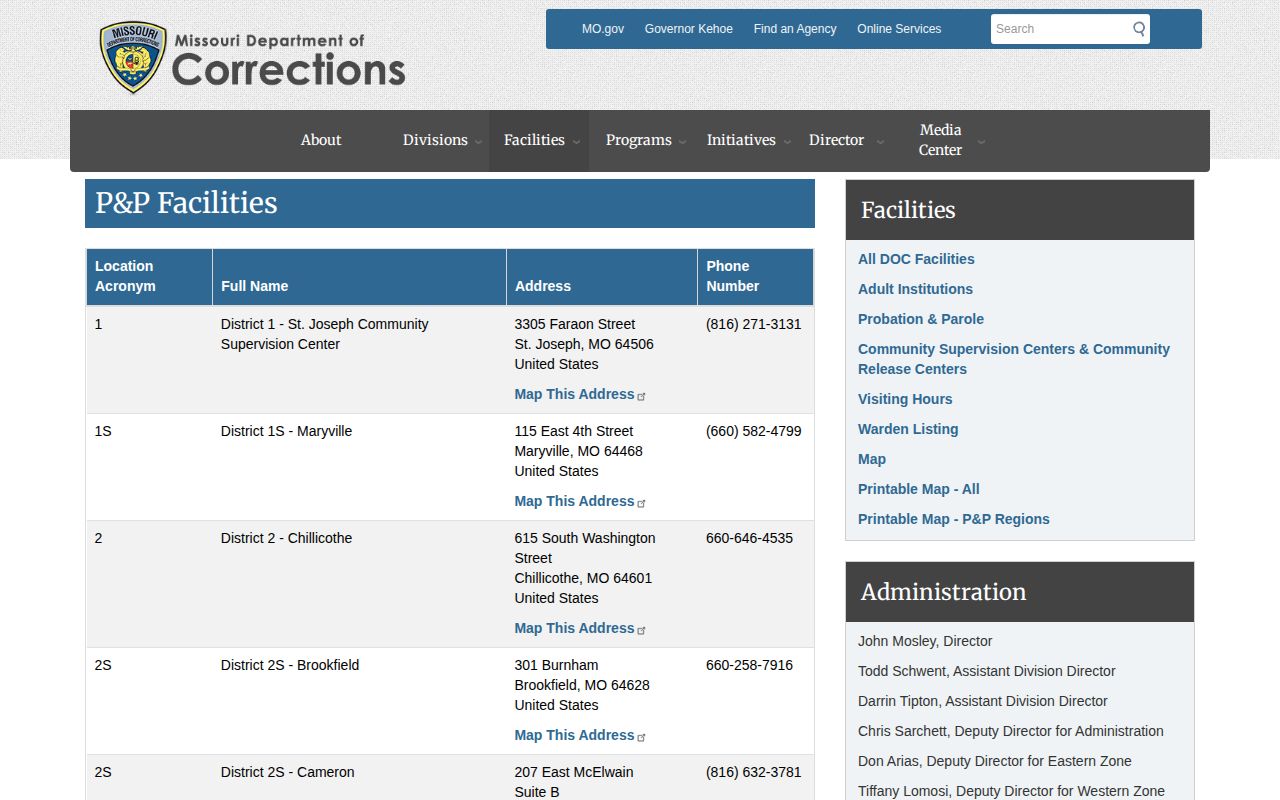
The separate Chillicothe and Cameron entries show why office assignment should be confirmed rather than inferred from distance.
Daviess Supervision Conditions and Absconders
Conditions are rules stated in the court order, Parole Board action, or MDOC supervision record. They vary by case. The public-information guidance permits release of the term and conditions of supervision, but a search result should not be used to guess a violation. A missed meeting is not the same as a court or board finding. Confirm current status through the assigned officer, responsible agency, and court record.
An absconder is alleged to have stopped complying with contact or supervision duties while the sentence remains active. It does not mean the person has discharged. MDOC says its Command Center tracks electronic monitoring and residential-center cases, investigates serious rule violations, and may issue arrest warrants when a person fails to return as required. A warrant should be verified with the issuing agency or court. The distinction matters because an old status label can persist after a later event.
How Daviess County Supervision Ends
Supervision ends through a recorded discharge or other lawful action, not when a public profile simply disappears. A discharge means MDOC authority over that sentence or supervision term has ended. For an active case, the public MDOC profile may show a field assignment and relevant dates. After discharge, the live offender search may no longer return the person. The nightly Sunshine file, a DOC records response, and the Daviess County court judgment can preserve the historical trail.
The court record matters most for probation. Read the judgment, probation order, later modification, revocation, satisfaction, or discharge entry. For parole and conditional release, pair MDOC data with the supervising office or Parole Board record. The broader Daviess County released inmate search and release-record path explains how to join a jail final movement with court and state records.
Missouri public-record access does not make every supervision detail open. Chapter 610 permits redaction or closure when another law protects a field. A narrow request for the supervision type, start and end dates, assigned office, and public discharge event is more useful than a demand for all notes.
Can Returned Property Prove Release?
The Daviess/DeKalb Regional Jail’s historical policy says staff inventory property on a Property Receipt Form, store it, and return it when the person is released or transferred. A signed receipt or acknowledgment can help resolve a property dispute. It may also corroborate the end of one regional-jail stay. Yet the form does not show that the person entered the community because the same return process applies to a transfer.
For reliable Daviess County release verification, pair the property record with the jail’s entry/release form or final chronological movement. Ask for the release or transfer code, the authority, and the receiving agency when one is recorded. If the movement was a transfer to MDOC, later parole or probation status belongs to the state system. Property paperwork alone cannot bridge those two custody stages.
The source is the regional jail’s policy and procedure manual. Its provisions date to an older manual, so present practice should be confirmed with the jail rather than assumed.
A focused request can ask for the Property Receipt Form, the entry/release form, and the last chronological movement entry for the same admission. Include the booked name, approximate dates, and booking number if known. Ask the custodian to redact protected fields and release the rest. When a receiving agency appears, search that agency’s record before checking parole or probation. This sequence keeps a regional-jail transfer separate from a later state release.
Note: “Release or transfer” on property paperwork proves neither community release nor a current Daviess County supervision assignment by itself.
Daviess Parole Hearings and Decisions
The Missouri parole-hearing process applies to eligible MDOC prisoners. A hearing is not a release. MDOC reports that the person may receive another hearing in one to five years or a future release date, and it gives an approximate eight-to-twelve-week decision period. The result for a named person should come from the institutional parole office, the Parole Board, Offender Search, or a focused records request.
The Board’s Blue Book appendices publish a rule-based hearing schedule tied to sentence length and offense, not a dated public calendar of named people. Eligibility depends on the judgment, offense date, governing statute, and MDOC sentence structure. Missouri law at RSMo § 217.690 supplies the parole authority framework. Covered dangerous felonies may also face the minimum-term rule in § 558.019. No charge label alone supports a sound release-date calculation.
The official hearing schedule source is useful for understanding when a case may become eligible. It is not proof that a hearing happened, that release was granted, or that a supervision office has accepted a home plan.
For a named decision, provide the DOC number to the Missouri Parole Board at 573-751-8488 or the institutional parole office. MDOC’s public guidance says a Parole Board release decision is among the supervision information that may be released. If routine channels do not supply the historical field, make a narrow Sunshine request and account for statutory confidentiality limits.